Showing posts with label Runes. Show all posts

Sunday, 24 July 2016

Runes: Fehu, Wealth

One of the major themes of the Rune Fehu (also known as Fee) is money, as you can well guess. The words fee, pecuniary, and peculate all come from the same root word as Fee. These words can be linked easily with similar words in other languages: in Gothic, faihu means “wealth” and “livestock”. In Latin, pecunia means “money”. These themes link with the concept of cattle or livestock with movable wealth in several other languages. In modern German, for example, vieh, (also based on the same root word) means cow. Latin pecu, Lithuanian pḗkus, Old High German fihu, Old Norse fē, Old Prussian pecku, Proto-Frisian fia, and Umbrian pequo all mean “cattle” or “herd”. Latin peculium links the two concepts with the meaning “riches in cattle”.

The concept of cattle even slips over into the Indo-Iranian and Indic side of the linguistic divide. Avestan pasu, and Sanskrit páśu are both related to cattle; Pali pasupalana means “cattlekeeping”. Given the sacred nature of the cow in the Indic tradition, they have plenty of words for cattle, but this particular word is of profound importance. It is the root for a recent epithet of Shiva: Pasupati, Lord of pasture and livestock. I believe, however, that this epithet was a more recent addition to Shiva’s repertoire. It’s clear that in the Rg Veda (written roughly between 1700–1100 BCE), the God called Pasupati was none other than Pushan, a God whose name also incorporates “pashu” with a simple inversion of the vowels. The concepts of wealth and cattle are thus both ancient and sacred with this symbol, especially given that the Sanskrit meaning also extends to "sacrificial" cattle.

With this etymological analysis alone we cover thousands of years and thousands of miles. What’s more, there’s no denying the links between all the words and meanings that go back well over 3000 years into recorded history and likely extend back prior to the known written record. Oddly enough, the poets who wrote glosses on the Runes also seem to have carried on this same knowledge without much variation. In the Rune poems, a collection of riddle-verses written between (approximately) the 8th and the 15th centuries in three different languages and locations, the meaning of “Fee” is remarkably kept quite consistent:

The Anglo Saxon Rune Poem (c. 8c)
(Feoh) byþ frofur fira gehwylcum;
(Wealth) is a comfort to all;

The Old Norwegian Rune Rhyme (c. 13c)
(Fé) vældr frænda róge;
(Wealth) is strife amongst kin;

The Old Icelandic Rune Poem (c. 15c)
(Fé) er frænda róg
(Wealth) is strife amongst kin

Even the ancients agree that money is a comfort, but also that unequal distribution of wealth to the kin can cause strife. There’s ancient wisdom you can take to the bank.

Monday, 18 July 2016

Fehu Reference Page

FEHU

Etymology

Proto Indo-European *peku-: from PIE *pek̑-, pluck or fleece (Pokorny, 797) compare PIE *plek̑-, weave (Pokorny, 834). Looking at later interpretations, the convenient correlation of *peku- to cattle alone is a bit hasty. It is clear milk/meat cows and fleece/meat sheep took separate paths from essentially the same root. Lehmann indicates the PIE meaning is closer to sheep, or fleece-bearing animal. 

Proto Germanic *fehu: from PIE *peku- (Kroonen, 134), compare PGmc *fahaz, sheep (Kroonen, 122) from PIE *pek̑-. It appears to be in PGmc where the differentiation between sheep and cattle is introduced into Germanic languages. The same occurs in Sanskrit and Avestan, where pasu means cattle (Monier-Williams, 571 pasava).

Old English Rune Poem feoh: cattle. From PGmc *fehu through Gothic faihu, movable wealth, money (Feist and Lehmann, F7). Oddly enough, OE feohtan means to fight, but is related to plucking wool rather than the concept of cattle. Still, it contains the root word feoh which relates well with the rog(e) in the Old Icelandic and Old Norse Rune Poems, meaning strife. The Old English Rune Poem does not contain the same warning of wealth being strife in the family, but maybe it was implied by the name in the first place?

Old Norse Rune Poem fe: OIsl fé, cattle - esp. sheep (Cleasby and Guðbrandur 132).

Old Icelandic Rune Poem fé: cattle. The two hints at the end of the poem are aurum and Fylkir. Latin aurum: gold. Would much have preferred Latin pecunia here, as it would relate directly back to the Latinate branch of the same PIE root word, *peku-. OIsl fylkir: Count, which I translate rather loosely given the modern Norwegian use of the word fylke for county or administrative region.

References


  1. Pokorny, Julius. Indogermanisches etymologisches Wörterbuch. Bern: Francke, 1959, 1989.
  2. Kroonen, Guus. Etymological Dictionary of Proto-Germanic. Leiden: Brill, 2013.
  3. Feist, Sigmund and Lehmann, Winfred P. A Gothic Etymological Dictionary. Leiden: Brill 1986.
  4. Monier-Williams, M. A. A Sanskrit-English dictionary, etymologically and philologically arranged, with special reference to Greek, Latin, Gothic, German, Anglo-Saxon, and other cognate Indo-European languages. Oxford: Clarendon Press, 1872.
  5. Cleasby, Richard and Guðbrandur, V. A concise dictionary of old Icelandic. Oxford: Clarendon Press, 1910.

Saturday, 9 July 2016

The Norwegian Rune Poem Reference Page


Reference pages such as this will expand as new information is added to them.

ᚠ Fé vældr frænda róge;
føðesk ulfr í skóge.

ᚢ Úr er af illu jarne;
opt løypr ræinn á hjarne.

ᚦ Þurs vældr kvinna kvillu;
kátr værðr fár af illu.

ᚬ Óss er flæstra færða
fǫr; en skalpr er sværða.

ᚱ Ræið kveða rossom væsta;
Reginn sló sværðet bæzta.

ᚴ Kaun er barna bǫlvan;
bǫl gørver nán fǫlvan.

ᚼ Hagall er kaldastr korna;
Kristr skóp hæimenn forna.

ᚾ Nauðr gerer næppa koste;
nøktan kælr í froste.

ᛁ Ís kǫllum brú bræiða;
blindan þarf at læiða.

ᛅ Ár er gumna góðe;
get ek at ǫrr var Fróðe.

ᛋ Sól er landa ljóme;
lúti ek helgum dóme.

ᛏ Týr er æinendr ása;
opt værðr smiðr blása.

ᛒ Bjarkan er laufgrønstr líma;
Loki bar flærða tíma.

ᛘ Maðr er moldar auki;
mikil er græip á hauki.

ᛚ Lǫgr er, fællr ór fjalle
foss; en gull ero nosser.

ᛦ Ýr er vetrgrønstr viða;
vænt er, er brennr, at sviða.

Monday, 4 July 2016

Icelandic Rune Poem Reference Page

Reference pages such as this will continue to expand as resources are added to them.
Vaksala Rune Stone

ᚠ Fé er frænda róg
ok flæðar viti
ok grafseiðs gata
aurum fylkir.
ᚢ Úr er skýja grátr
ok skára þverrir
ok hirðis hatr.
umbre vísi
ᚦ Þurs er kvenna kvöl
ok kletta búi
ok varðrúnar verr.
Saturnus þengill.
ᚬ Óss er algingautr ok
ásgarðs jöfurr,
ok valhallar vísi.
Jupiter oddviti.
ᚱ Reið er sitjandi sæla
ok snúðig ferð
ok jórs erfiði.
iter ræsir.
ᚴ Kaun er barna böl
ok bardaga [för]
ok holdfúa hús.
flagella konungr.
ᚼ Hagall er kaldakorn
ok krapadrífa
ok snáka sótt.
grando hildingr.
ᚾ Nauð er Þýjar þrá
ok þungr kostr
ok vássamlig verk.
opera niflungr.
ᛁ Íss er árbörkr
ok unnar þak
ok feigra manna fár.
glacies jöfurr.
ᛅ Ár er gumna góði
ok gott sumar
algróinn akr.
annus allvaldr.
ᛋ Sól er skýja skjöldr
ok skínandi röðull
ok ísa aldrtregi.
rota siklingr.
ᛏ Týr er einhendr áss
ok ulfs leifar
ok hofa hilmir.
Mars tiggi.
ᛒ Bjarkan er laufgat lim
ok lítit tré
ok ungsamligr viðr.
abies buðlungr.
ᛘ Maðr er manns gaman
ok moldar auki
ok skipa skreytir.
homo mildingr.
ᛚ Lögr er vellanda vatn
ok viðr ketill
ok glömmungr grund.
lacus lofðungr.
ᛦ Ýr er bendr bogi
ok brotgjarnt járn
ok fífu fárbauti.
arcus ynglingr.

References:
Select Icelandic Poems


Sunday, 3 July 2016

Anglo-Saxon Rune Poem Reference Page

Reference pages such as this will continue to expand as resources are added to them.

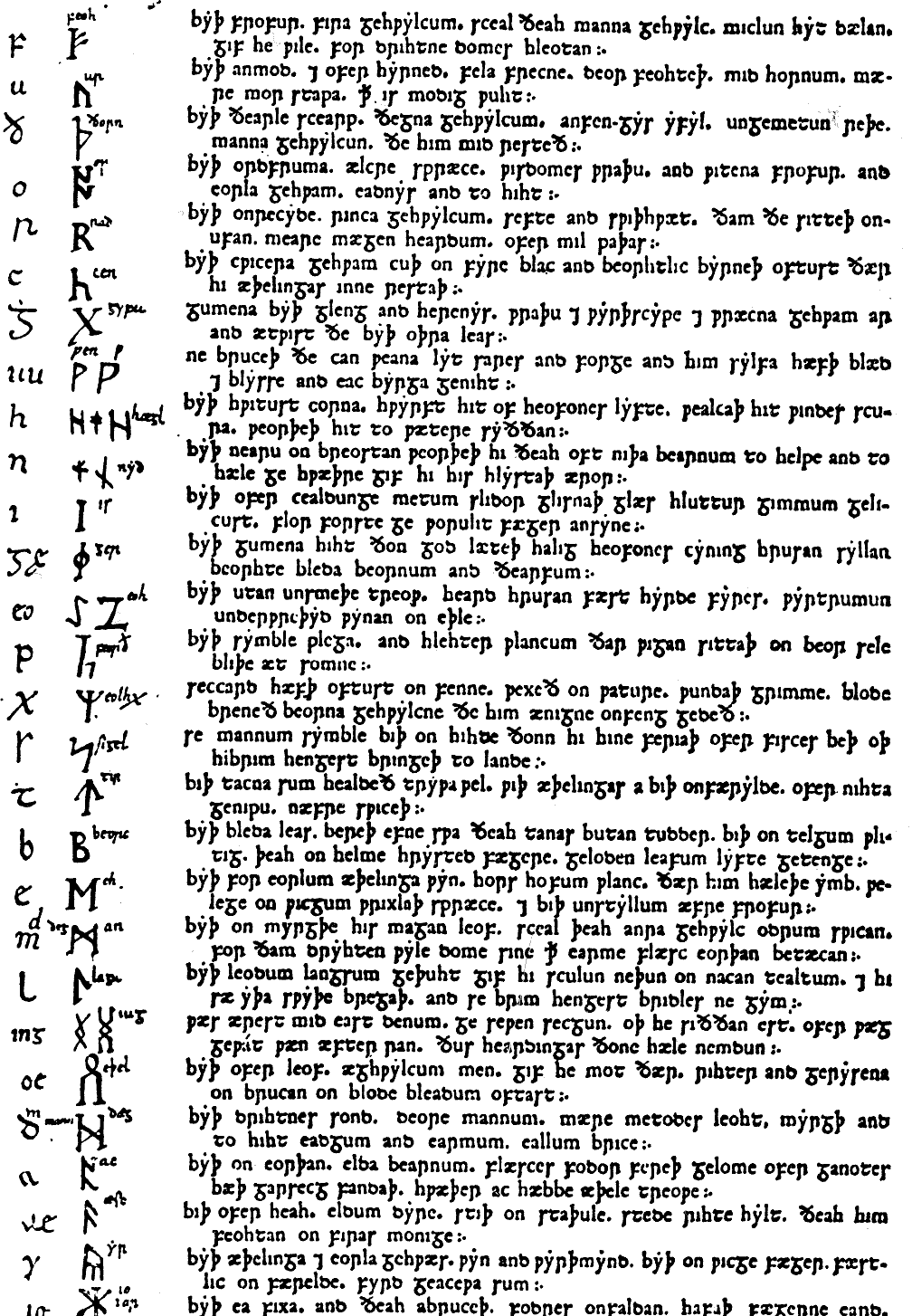
Copy of original manuscript

Original Anglo-Saxon:


Feoh byþ frofur fira gehwylcum;
sceal ðeah manna gehwylc miclun hyt dælan
gif he wile for drihtne domes hleotan.
Ur byþ anmod ond oferhyrned,
felafrecne deor, feohteþ mid hornum
mære morstapa; þæt is modig wuht.
Ðorn byþ ðearle scearp; ðegna gehwylcum
anfeng ys yfyl, ungemetum reþe
manna gehwelcum, ðe him mid resteð.
Os byþ ordfruma ælere spræce,
wisdomes wraþu ond witena frofur
and eorla gehwam eadnys ond tohiht.
Rad byþ on recyde rinca gehwylcum
sefte ond swiþhwæt, ðamðe sitteþ on ufan
meare mægenheardum ofer milpaþas.
Cen byþ cwicera gehwam, cuþ on fyre
blac ond beorhtlic, byrneþ oftust
ðær hi æþelingas inne restaþ.
Gyfu gumena byþ gleng and herenys,
wraþu and wyrþscype and wræcna gehwam
ar and ætwist, ðe byþ oþra leas.
Wenne bruceþ, ðe can weana lyt
sares and sorge and him sylfa hæfþ
blæd and blysse and eac byrga geniht.
Hægl byþ hwitust corna; hwyrft hit of heofones lyfte,
wealcaþ hit windes scura; weorþeþ hit to wætere syððan.
Nyd byþ nearu on breostan; weorþeþ hi þeah oft niþa bearnum
to helpe and to hæle gehwæþre, gif hi his hlystaþ æror.
Is byþ ofereald, ungemetum slidor,
glisnaþ glæshluttur gimmum gelicust,
flor forste geworuht, fæger ansyne.
Ger byÞ gumena hiht, ðonne God læteþ,
halig heofones cyning, hrusan syllan
beorhte bleda beornum ond ðearfum.
Eoh byþ utan unsmeþe treow,
heard hrusan fæst, hyrde fyres,
wyrtrumun underwreþyd, wyn on eþle.
Peorð byþ symble plega and hlehter
wlancum [on middum], ðar wigan sittaþ
on beorsele bliþe ætsomne.
Eolh-secg eard hæfþ oftust on fenne
wexeð on wature, wundaþ grimme,
blode breneð beorna gehwylcne
ðe him ænigne onfeng gedeþ.
Sigel semannum symble biþ on hihte,
ðonne hi hine feriaþ ofer fisces beþ,
oþ hi brimhengest bringeþ to lande.
Tir biþ tacna sum, healdeð trywa wel
wiþ æþelingas; a biþ on færylde
ofer nihta genipu, næfre swiceþ.
Beorc byþ bleda leas, bereþ efne swa ðeah
tanas butan tudder, biþ on telgum wlitig,
heah on helme hrysted fægere,
geloden leafum, lyfte getenge.
Eh byþ for eorlum æþelinga wyn,
hors hofum wlanc, ðær him hæleþ ymb[e]
welege on wicgum wrixlaþ spræce
and biþ unstyllum æfre frofur.
Man byþ on myrgþe his magan leof:
sceal þeah anra gehwylc oðrum swican,
forðum drihten wyle dome sine
þæt earme flæsc eorþan betæcan.
Lagu byþ leodum langsum geþuht,
gif hi sculun neþan on nacan tealtum
and hi sæyþa swyþe bregaþ
and se brimhengest bridles ne gym[eð].
Ing wæs ærest mid East-Denum
gesewen secgun, oþ he siððan est
ofer wæg gewat; wæn æfter ran;
ðus Heardingas ðone hæle nemdun.
Eþel byþ oferleof æghwylcum men,
gif he mot ðær rihtes and gerysena on
brucan on bolde bleadum oftast.
Dæg byþ drihtnes sond, deore mannum,
mære metodes leoht, myrgþ and tohiht
eadgum and earmum, eallum brice.
Ac byþ on eorþan elda bearnum
flæsces fodor, fereþ gelome
ofer ganotes bæþ; garsecg fandaþ
hwæþer ac hæbbe æþele treowe.
Æsc biþ oferheah, eldum dyre
stiþ on staþule, stede rihte hylt,
ðeah him feohtan on firas monige.
Yr byþ æþelinga and eorla gehwæs
wyn and wyrþmynd, byþ on wicge fæger,
fæstlic on færelde, fyrdgeatewa sum.
Iar byþ eafix and ðeah a bruceþ
fodres on foldan, hafaþ fægerne eard
wætre beworpen, ðær he wynnum leofaþ.
Ear byþ egle eorla gehwylcun,
ðonn[e] fæstlice flæsc onginneþ,
hraw colian, hrusan ceosan
blac to gebeddan; bleda gedreosaþ,
wynna gewitaþ, wera geswicaþ.


References:
Runic and Heroic Poems of the Old Teutonic Peoples - Bruce Dickins 1915
The Anglo-Saxon Runic PoemA Critical Reassessment - Aya Maria Sofia Van Renterghem (Thesis)


Saturday, 2 July 2016

Origin Story

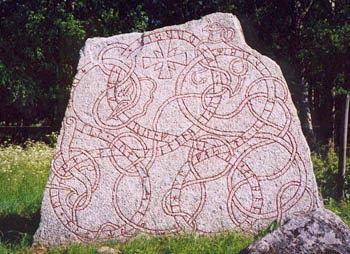
Lingsberg Runestone

“To learn the most profound truths, begin with the alphabet”
- Japanese proverb

The Runes are an ancient alphabet. They have been used by the Germanic tribes since approximately 2000 years ago. They have been found from North America to Constantinople. Though they have been used and written about for well over 1500 years, I personally think that the ideas they represent have been around for far longer than the symbols themselves. Humans are conservative, and they can carry knowledge - sometimes very unwittingly - for thousands of years without blemishing it. Beauty and the Beast, the story we know and love, may have been transported through time for over 5000 years. Turns of phrase like "goods and chattels", still used in legalese, can be dated to Proto-Indo-European language of about the same vintage. We carry a lot of historical baggage, but it's unnoticeable because nobody realises they're carrying it. I believe it is the same way with the Runes: stuff that was important to us, resonated with us, and was carried by us in our culture (knowingly or not) is stuck to the Runes. I'm interested in using any method at all to dig for that stuff, and hopefully find why it stuck.

I’ve studied the Runes for more than 25 years. Unfortunately, the process of studying something tends to reveal gaps in knowledge rather than fill them. Recently, I’ve been trying to patch up a major gap in my knowledge of the Runes: the sources of the ideas and names that go with the characters. Here is a primer so you can hopefully join me in this study - if you haven't already started.

There are 24 symbols in the Runic alphabet I study. The word “alphabet” here is inappropriate because “alphabet” comes from the Greek characters alpha and beta put together. This is just like the Hebrew aleph-bet, which comes from the names of the first two Hebrew characters, aleph and beth. The first six letters of the Rune row make up its name, and they are F, U, þ (th), A, R, K, so we call it the Fuþark. This should be pronounced foo (like Mr. T would say) thark (like saying “shark” with a lisp). The Fuþark of 24 Runes is the “Elder” Fuþark because there are a few different versions of the Runes through history, and this one happens to be the oldest. Some languages needed more or fewer sounds, some languages needed different sounds, so the Fuþark had to adapt to new realities as languages changed. The Elder Fuþark is the earliest recorded Fuþark we have, and therefore the closest to the ancient ideas I am trying to study.

Each Rune has a name and a meaning. Since Runes have been around a long time, the meanings have multiplied. Words that describe the Runes have also grown in number over the years. The first Rune represents the letter “F”, and in English, we can call it “Fee”. In the language spoken by the ancient Germanic tribes, called “Proto Germanic”, this Rune was likely called something like “Fehu”, meaning “movable property”. We’re not sure if it was really called that, but linguistic research provides us with a lot of accurate tools to figure out how ancient languages sounded, so we think it’s a pretty good guess. A lot of other languages have similar words based on the same sound and concept, so it’s possible to reconstruct older languages based on the sounds and meanings of these words. This gives us the capability to drill down into the historical and pre-historical record – through language and myth – to find out where the Rune names came from.

This etymological path is one way to mine the vein of Runic knowledge. Another is poetic. There are several poems and signatures that may give hints as to Runic meanings. Some, like the Anglo-Saxon Rune Poem, explain in sideways references what each symbol might mean. Some, like the Cynewulfian Signatures, are even more riddle-like than the poems. Many of the references are eerily similar, or at least comparable, in scripts that occur over the stretch of about 500 years. The Anglo-Saxon Rune Poem at least has a full listing of all the Elder Fuþark Runes, and it is a good jumping-off point for the study of the ideas behind their meanings.

It is important to remember that these ideas are not simply as old as this poem. The linguistic, historical and archaeological evidence all points to the Runic tradition itself being at least 1500 years old. The linguistic roots go even deeper. For instance, there are two separate references to horses in the Elder Futhark, but the German tribes of the age of Tacitus were by no means a horse-oriented society. Their cavalry was, at best, pathetic in comparison with Roman auxilia of the time. The root of one of the Runic symbols, *ekwos, meaning horse, goes all the way back to the time of the Indo-Europeans, who were a horse (*ekwos-) riding (*reidh-) people. These roots come up to us through early Germanic, close to the Indo-European in both sound and meaning. Though one of these (*ekwos) did not survive the transition to the Younger Futhark, there is a definite chain of ideas from deep antiquity to the present. 

Our most ancient – and yet historically silent – ancestors speak volumes to us through the transmitted knowledge embodied in the Runes.


FAQs
What's a Practical Occultist?
Anglo-Saxon Rune Poem Reference Page